English
 عربى
 русский
 简体中文





2026-10-21
الصفحة الرئيسية / أخبار / أخبار الصناعة / Dynamic Melt Mixer: Improving Masterbatch Mixing Uniformity in Melt Spinning
A dynamic melt mixer rarely gets much attention on a spinning line until something goes wrong. Then it becomes the first component everyone blames: a streak in the yarn, a filter that packs off far too quickly, a shade that drifts between lots. In masterbatch adding for melt direct spinning, the mixer is the place where polymer and additive either become one uniform melt or stay two materials travelling together. This article walks through what a dynamic melt mixer does, how it differs from a static unit, and how to specify and run one without over-engineering the line.
In plain terms, a dynamic melt mixer is an inline unit with a motor-driven rotor inside a heated housing. It sits in the melt path, normally downstream of the masterbatch dosing point and upstream of the spinning pump or manifold, and it imposes shear on the polymer as the melt passes through.
The important word here is "imposed". A static mixer, the familiar array of twisted elements inside a pipe, has no drive. Its mixing energy comes entirely from the pressure the polymer gives up as it flows around those elements. That works well at a stable design point, but the shear rate drops when throughput drops, and it shifts again whenever viscosity or additive ratio changes.
A dynamic mixer decouples mixing from flow rate. Rotor speed is set independently, so roughly the same shear intensity can be held at 60 percent output as at full output. For a plant running several grades, or one that needs to change colour quickly, that independence is usually the main reason to pay for a driven unit rather than a passive one.
Both technologies disperse masterbatch; they simply pay for it in different currencies. The table below summarises the trade-offs we see most often when a line is being specified or retrofitted.
| Aspect | Static mixer | Dynamic melt mixer |
|---|---|---|
| Mixing energy source | Pressure drop across fixed elements | Motor-driven rotor, adjustable |
| Behaviour at low output | Shear falls with flow, dispersion weakens | Speed raised to compensate |
| Response to a ratio change | Slow, limited by residence volume | Fast, speed and dosing adjusted together |
| Colour and grade changeover | Longer purge, more transition scrap | Shorter transition, less off-grade material |
| Pressure drop | Relatively high and flow-dependent | Moderate and predictable by design |
| Maintenance profile | No moving parts, periodic cleaning | Seals and bearings need inspection |
| Utilities and footprint | Minimal | Motor, heating, controls, more space |
| Typical fit | Single product, stable output, tight budget | Multi-grade, frequent changeover, demanding dispersion |
A melt direct spinning masterbatch adding system is a short chain of equipment that has to work as one. Main polymer melt arrives from the extruder or from the polymerization line; a gravimetric feeder drops masterbatch into that stream; the mixer homogenises the combination; a filter catches gels and contaminants; the spinning pump meters the melt to the spin pack.
The mixing step is where much of the system's flexibility comes from. The same hardware can handle colour masterbatch, functional additives, and let-down ratios that range from a few percent down to well below one percent, provided the rotor geometry and the dosing accuracy are matched to the job.
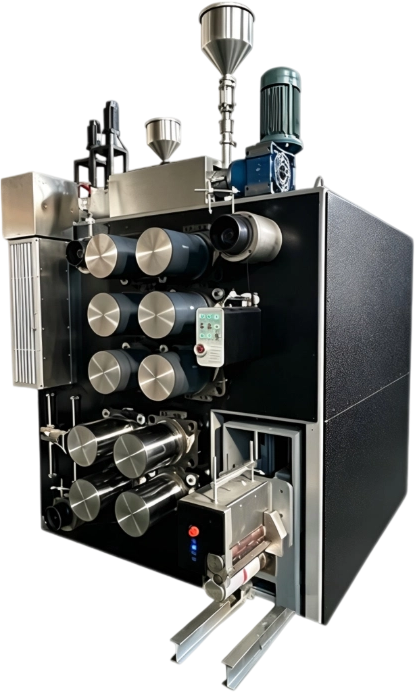
 Dynamic Mixer for Uniform Melt BlendingPatented inline mixer for uniform chemical fiber and plastic melts, available in multiple pressure, diameter, capacity and heating configurations.View Product →
Because the mixer is only one link in that chain, it is worth looking at the complete arrangement rather than the mixer alone. Dosing accuracy, residence time between the feeder and the rotor, and the filtration stage downstream all influence the final dispersion just as much as rotor speed does.
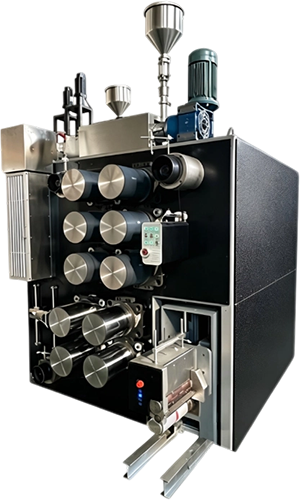
 Melt Direct Spinning Masterbatch Adding EquipmentOnline masterbatch injection and dynamic mixing system for melt direct spinning, supporting precise color and functional additive dosing with flexible grade switching.View Product →
For a deeper look at how mixing uniformity is achieved in practice, including the process reasoning behind equipment choices, our technical note on mixing uniformity in masterbatch adding equipment walks through the same problem from the process side.
Clearances, the number of mixing zones, and the way the rotor profile pushes melt outward and back all determine how much shear the polymer actually sees. A geometry that is too aggressive raises melt temperature and can degrade heat-sensitive additives; one that is too gentle leaves the masterbatch sitting in streaks. The right compromise depends on viscosity and on how finely the additive has to be distributed.
A variable-frequency drive with torque feedback is the practical baseline. Torque trending tells an operator more about changing melt condition than a pressure gauge alone, and a controlled ramp protects the rotor when a cold line is started. Turn-down capability matters as much as top speed: many lines spend most of their life well below nameplate output.
Every internal volume holds melt that is not moving as fast as the rest. Zones that create dead spots become colour-change problems and, with some polymers, gel or degradation problems. Jacket design and the internal flow path should be reviewed together, not separately.
The shaft seal is the part most likely to end a run early. High melt temperature, thermal cycling and abrasive fillers all shorten seal life, and a seal failure usually shows up as a polymer leak rather than as a mixing problem. Wear-resistant surface treatment on the rotor and housing is worth considering when mineral fillers or high additive loadings are involved.
Operators rarely judge a mixer by its drawing. They judge it by what happens downstream over a shift, a week, a campaign. Signs that dispersion is under control include:
When two or three of these indicators move in the right direction at once, the mixer is doing its job. When only pressure drop improves, something else has probably changed.
Mixing problems are usually specification problems wearing a disguise. Answering these questions early saves a lot of trial and error later:
Most of the failures we hear about are installation or start-up issues rather than design faults. Support the unit properly so that piping loads do not distort the housing. Heat the mixer through before polymer reaches it, and bring the rotor up to speed only when the melt is genuinely molten. Log torque and speed together with throughput, because the combination is far more informative than either value alone.
On the maintenance side, plan seal inspection on a calendar basis rather than waiting for a leak, and keep a record of rotor condition after each cleaning so that wear is visible before it becomes a dispersion problem. Where an existing line already has a mixing section but suffers from poor dispersion or long changeovers, a targeted retrofit is often more economical than replacing the whole melt train; our equipment upgrading service covers that kind of assessment.
Jiaxing Shengbang Mechanical Equipment Co., Ltd. builds its masterbatch adding and melt mixing equipment in-house, which matters when a mixer has to match a specific line rather than a catalogue page. The production side includes CNC machining, a German SCHENCK dynamic balancing machine for rotating parts, plasma spray coating equipment, and a Barmag hot godet temperature calibration instrument. For a driven mixer, that combination is practical: the rotor is a rotating component that must be balanced, the surfaces that contact melt benefit from controlled coating, and the temperature calibration discipline carries over from hot godet work.
The company also operates a multifunctional flexible pilot spinning machine and an open spinning laboratory, so a mixing question can be tested on a small line before it becomes a decision on a full production line. With technical development and overseas sales based in Shanghai and manufacturing and experimental facilities in Haining and Nantong, projects can move from sample to equipment without changing hands too often.
A dynamic melt mixer is not the right answer for every line. Where a single product runs at a steady output for months, a well-chosen static element can be perfectly adequate and cheaper to own. But once output swings, grades change, or the additive has to be dispersed at low let-down ratios, the ability to set mixing intensity independently of flow usually pays for the drive several times over.
If you are weighing the options for a specific polymer and output range, describe the process to us — melt index, masterbatch type, target ratio, throughput window and the changeover pattern you expect. Those five numbers usually settle the question faster than a long specification document.

العنوان: : رقم 1298، طريق تشوان، منطقة التنمية الاقتصادية والتكنولوجية، مدينة جياشينغ، مقاطعة تشجيانغ
الهاتف: +86 19057031687
التلفون: 86-0573-83777752
البريد الإلكتروني: [email protected]
Jiaxing Shengbang Mechanical Equipment Co., Ltd. جميع الحقوق محفوظة. مصنعي المكونات الرئيسية لآلات الغزل